
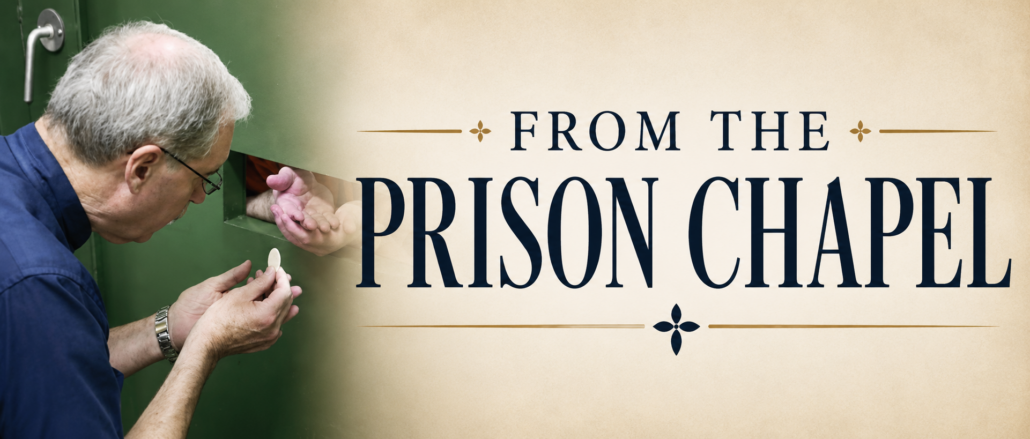
Thirtieth Sunday in Ordinary Time
THE HARDEST PERSON TO LOVE MAY BE THE ONE RIGHT NEXT TO YOU And Sometimes That Person Is Yourself
📖 Exodus 22:20–26 | Psalm 18 | 1 Thessalonians 1:5c–10 | Matthew 22:34–40
Someone once said that living with other people is the greatest test of Christian love. Whoever said that obviously never had to share a cell. There are people who complain about everything, borrow things and forget to return them, and snore so loudly you wonder whether a motorcycle is running inside the building. And the worst part? You cannot exactly say, “I’ve had enough. I’m going home!”
One man supposedly asked his cellmate, “Is there anything about me you actually like?” The fellow thought for a moment and answered, “Yeah. When you’re asleep.” We laugh because we recognize something about human nature. Loving people is easy in theory. It’s the actual people who make it difficult.
Today Jesus tells us that the greatest commandments are to love God and love our neighbor as ourselves. Notice what He doesn’t say. He doesn’t say we must like everybody, trust everybody, or pretend nobody has hurt us. He simply says we must love. And love is more than a feeling. Love is refusing to let another person’s behavior turn us into someone we don’t want to become.
That matters especially here. There are many things in prison you cannot control: when the doors open, what is served for dinner, or who lives next to you. But something still belongs to you: the freedom to decide what kind of man you will be. You can refuse to humiliate someone who is struggling. You can listen to a man who hasn’t received a letter in months. You can walk away from an argument. Sometimes the strongest man in the room isn’t the one who can win a fight. It’s the one who could start one and chooses not to.
In Exodus, God commands His people not to mistreat the stranger, the widow, the orphan, or the poor. These were people society easily overlooked. Yet God says, “If they cry out to me, I will hear them.” Think about that. The Creator of the universe listens to people the world barely notices. Perhaps you know what it feels like to be forgotten or remembered mainly for your mistakes. But God hasn’t forgotten you. He knows your name, not just your number. He knows what you have done, but He also sees who you can become.
And that brings us to something we rarely discuss. Jesus says, “Love your neighbor as yourself.” But what if the person you find hardest to love is yourself? Have you ever looked back and wondered how different life might have been if you had made just one different decision? One conversation you wish you could take back? One moment when you wish you had walked away?
Sometimes we become our own harshest judges. A voice inside keeps repeating, You ruined everything. You’ll never amount to anything. But there is an enormous difference between taking responsibility and believing we are worthless. Guilt says, “I did something wrong.” Shame whispers, “There is something wrong with me.” Jesus wants us to face the first without surrendering to the second.
Real repentance means acknowledging the harm we have caused, accepting responsibility, and repairing what we can. Some relationships may never be restored. Some people may never forgive us. But our failures need not become the final definition of our lives. God doesn’t love us because we have changed. We begin to change because God loves us.
Paul praises the Thessalonians because they turned away from their old ways and began living differently. Their faith became visible through their actions. And perhaps that is how your own transformation will happen. Someone notices that you no longer respond to insults with anger, that you listen more than you argue, that you have become someone others can trust. No applause, no awards, perhaps not even a word of appreciation. But something extraordinary is happening: you are becoming a different man.
You may not be able to change where you sleep tonight or how many years remain on your sentence. But you can change how you treat someone tomorrow. You can decide that another person’s suffering matters. And you can begin looking at yourself with the mercy God asks you to show others. Not with excuses or self-pity, but with the determination to become better than yesterday. If God hasn’t given up on you, why should you give up on yourself?
So tomorrow morning, when that difficult fellow starts complaining again, remember today’s Gospel. He may still talk too much, get on your nerves, and snore like a freight train. Jesus never promised to make your neighbor easier to live with. But He offers you the grace to become someone different.
Perhaps that is the miracle God wants to begin in your life. Not erasing your past, but refusing to let it destroy your future. Not changing everyone around you, but transforming the person within you.
Because the walls around you may remain exactly where they are. But with God’s help, the walls inside your heart can begin to come down.
And sometimes, my brothers, that is where the greatest freedom begins.
A PRAYER FROM THE HEART
Lord Jesus,
You know our mistakes, our regrets, and the people we miss. You know the conversations we wish we could take back and the nights when our thoughts refuse to let us sleep. You understand the burdens we carry, even those we have never shared with anyone.
Lord, we cannot change yesterday, and sometimes we are frightened of tomorrow. But we still have today. Help us not to waste it.
When anger rises, give us patience. When someone is lonely, help us notice. When another person is struggling, remind us that we may be the kindness he has been praying for.
Teach us to take responsibility without losing hope, to acknowledge our mistakes without becoming prisoners of them, and to forgive ourselves without forgetting what we have learned.
Bless the people we love and cannot hold tonight. Protect our families, heal the wounds we have caused wherever healing is possible, and give us peace about what we cannot change.
Above all, Lord, don’t let these walls make our hearts smaller. Make us more compassionate, more honest, more patient, and more capable of love.
And when another day ends, help us recognize that even if nothing around us has changed, something good may have begun to change within us.
Because we don’t want to spend our lives merely counting the days.
We want to use those days to become the men You created us to be.
Amen.
Download this Homily in Spanish



Leave a Reply
Want to join the discussion?Feel free to contribute!